Characteristics and installation methods of brushless DC pumps
Brushless DC water pump pumping water and oil, coolant and acid-base solution requirements
The pump head flow and parameter definitions are all set with reference to water. The power head and flow of the pump are related to the viscosity, temperature and medium of the solution.
Brushless DC pump
Pumping: Oil viscosity is a very important indicator. Only the viscosity close to water can refer to the parameter table of the water pump to select the water pump. For example, the model of the water pump is DC40-2470, voltage 24V, current 1.2A, head 7M, flow 66OL/H, when this When the model is used for pumping oil, the current will rise, and the head and flow will be greatly reduced. The higher the viscosity, the greater the current rise, and the lower the head and flow. At this time, if you continue to choose the DC40-2470 water pump, the water pump will be burnt out, because the maximum current limit of the water pump is 1.2A, so if you need to make some adjustments when pumping oil, try to choose a pump with a lower power. Make up for the impact of increased current on the pump body. For example, when pumping oil, we choose the model DC40-2440 (current 0.5A when pumping water and 4M head). When it is put in the oil, the current of the water pump will rise to 1A or 1.2A, so that the water pump is still in a safe range. Communicate with the manufacturer to resolve.
Pumping acid and alkali solutions: The pump can withstand certain acid and alkali solutions, and the corrosion resistance depends on the pH concentration and chemical composition of the circulating solution. It needs to be tested by the user. The material of the pump is customized material, and the material can be changed within a certain range according to the material characteristics to achieve different acid and alkali resistance.
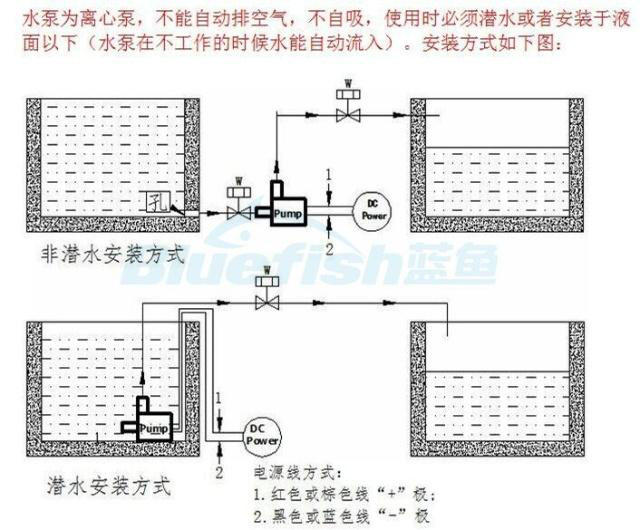
Brushless DC pump installation method